
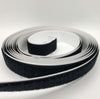
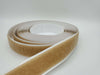
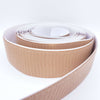
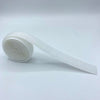
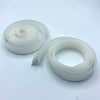
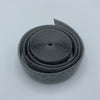
FR Hook & Loop Fasteners, Adhesive-backed
SKU# FRABH100


These hook and loop fasteners have a PSA backing (Pressure-Sensitive Adhesive), and are ideal for light-to-medium duty applications, such as adhering lighter weight panels or holding down seat cushions in automobiles, boats, trains, and airplanes. The adhesive performs well in direct sunlight and high temperatures on a wide variety of surfaces, such as glass, metal, painted metal, and rigid plastics. Avoid with plywood, EVA, and PVC.
Fire-retardant adhesive-backed hook and loop fasteners. Colloquially known as "Velcro". HALCO® brand. Sold in 27-27.5 yard rolls.
Available in black & beige, and in 1-inch or 2-inch widths.
White and gray colors have a 2-week lead time. Contact us for custom colors.
Includes FAA burn certificate for 25.853(a). Also available in sew-on or tack-down.
Hook and loop sold separately.
Est. lead time: 4-8 weeks
| Length | 27-27.5 yards |
| Width | 1-inch or 2-inch |
| Weight (excl. adhesive) |
Hook, 1-inch: 0.007 oz/inch Loop, 1-inch: 0.008 oz/inch Hook, 2-inch: 0.015 oz/inch Loop, 2-inch: 0.016 oz/inch |
| Thickness (incl. adhesive) |
0.095 inch |
| Fastener Material | 100% Nylon |
| Adhesive Material | Rubber, Clear-Yellow |
| Colors | Black, Beige, White, and Gray |
| Maximum Temperature |
149°F (Adhesion Failure) 392°F (Fastener Melting) |
| Peel Strength |
1.12 lb (1-inch) 2.24 lb (2-inch) |
| Shear Strength |
22.7 lb (1-inch) 45.4 lb (2-inch) |
| Breaking Strength |
169 lb (Loop, 1-inch), 205 lb (Hook, 1-inch) 378 lb (Loop, 2-inch), 416 lb (Hook, 2-inch) |
| Durability (to 50% strength) | 20,000 peels |
| Application Temperature | 65°F-75°F with relative humidity 40-60% |
| Cure Time | 80% adhesion within 1 hour. Full strength adhesion within 48 hours. |
| Flammability |
14 CFR (FAR) 25.853(a), Vertical Burn California Technical Bulletin 117 FMVSS 302, Automotive Flammability |

|
This product is recommended for use in automotive interiors. |
 |
This product is recommended for use in all types of aircraft and rotorcraft, but see the Note below. |
 |
This product is recommended for use in Marine applications. |
 |
This product is acceptable for use in Railway applications when used as a fastener under the small part exemption (49 CFR 238, Appendix B, Footnote 10). This product may also pass other rail tests. Contact us for more information. |
Note: Hook and Loop ("Velcro") failures are common in Vertical Burn testing across all brands. Most fasteners are manufactured from nylon or similar synthetic materials that are inherently flammable. These materials typically pass the standalone 12-second Vertical Burn test because they liquefy and drip during combustion; this process carries the flame away from the sample, allowing it to self-extinguish.
However, when the same fastener is attached to a substrate like leather, it is prevented from dripping. This causes the flame to linger and intensify on the material, leading to a failure. In our experience, this occurs in approximately 20% of cases. Leather is particularly problematic as it tends to shrink and contract, further concentrating the flame.
For projects involving Oil Burn Testing a simple solution may be for your laboratory to test the Hook and Loop independently, provided the Oil Burn test also passes.
For all other testing categories, there are unfortunately no ideal solutions. The available options include:
- Applying a flame retardant: This is generally ineffective as the treatment cannot sufficiently penetrate the nylon fibers.
- Sewing instead of gluing: While this may slightly improve performance, the fundamental combustion issue remains.
- Switching brands: This rarely resolves the issue, especially when testing on leather, as the substrate itself is often a primary contributor to the failure.
- Utilizing "Radiant Panel" rated fasteners: Specialized fasteners are designed for these conditions. This is the only method to guarantee a passing result, though it does involve a significantly higher cost.
Sometimes the best fastener is one that skips the stitching altogether. Bramport Supply Co.'s FR adhesive hook loop fasteners give fabricators a fast, dependable way to secure panels, cushions, and trim without compromising on fire safety or quality.
Built with a pressure-sensitive adhesive (PSA) backing on HALCO® brand hook and loop tape, this aerospace adhesive hook loop tape is engineered for light-to-medium duty applications across aircraft, automotive, marine, and railway interiors, all backed by an FAA burn certificate for 25.853(a).
Why Fabricators Trust Our Fire Retardant Adhesive Hook & Loop:
- PSA backing holds reliably on glass, metal, painted metal, and rigid plastics
- High-temp adhesive performs in direct sunlight, with adhesion stable up to 149°F
- Meets 14 CFR (FAR) 25.853(a) Vertical Burn, Cal TB 117, and FMVSS 302 standards
- Ideal for seat cushions, lightweight panels, and removable trim
- Available in 1-inch and 2-inch widths and four colors (black, beige, white, gray)
Multi-Industry Compliance at a Glance:
- Aerospace: Recommended for all aircraft and rotorcraft interiors
- Automotive: Suitable for FMVSS 302-compliant vehicle interiors
- Marine: Recommended for marine cabin applications
- Railway: Approved as a fastener under the small part exemption (49 CFR 238, Appendix B, Footnote 10)
What surfaces does the adhesive work on?
PSA backing bonds well to glass, metal, painted metal, and rigid plastics. Avoid plywood, EVA, and PVC for best results.
How is it sold?
In 27 to 27.5 yard rolls, with hook and loop sold separately. Choose 1-inch or 2-inch width and your preferred color.
What flammability standards does it meet?
14 CFR (FAR) 25.853(a) Vertical Burn, California Technical Bulletin 117, and FMVSS 302. An FAA burn certificate is included.
How long until full adhesion?
Expect 80% adhesion within one hour and full strength within 48 hours, applied at 65–75°F.